
Sappha Hopes You Feel Sad And Sexy When Listening To Her Music
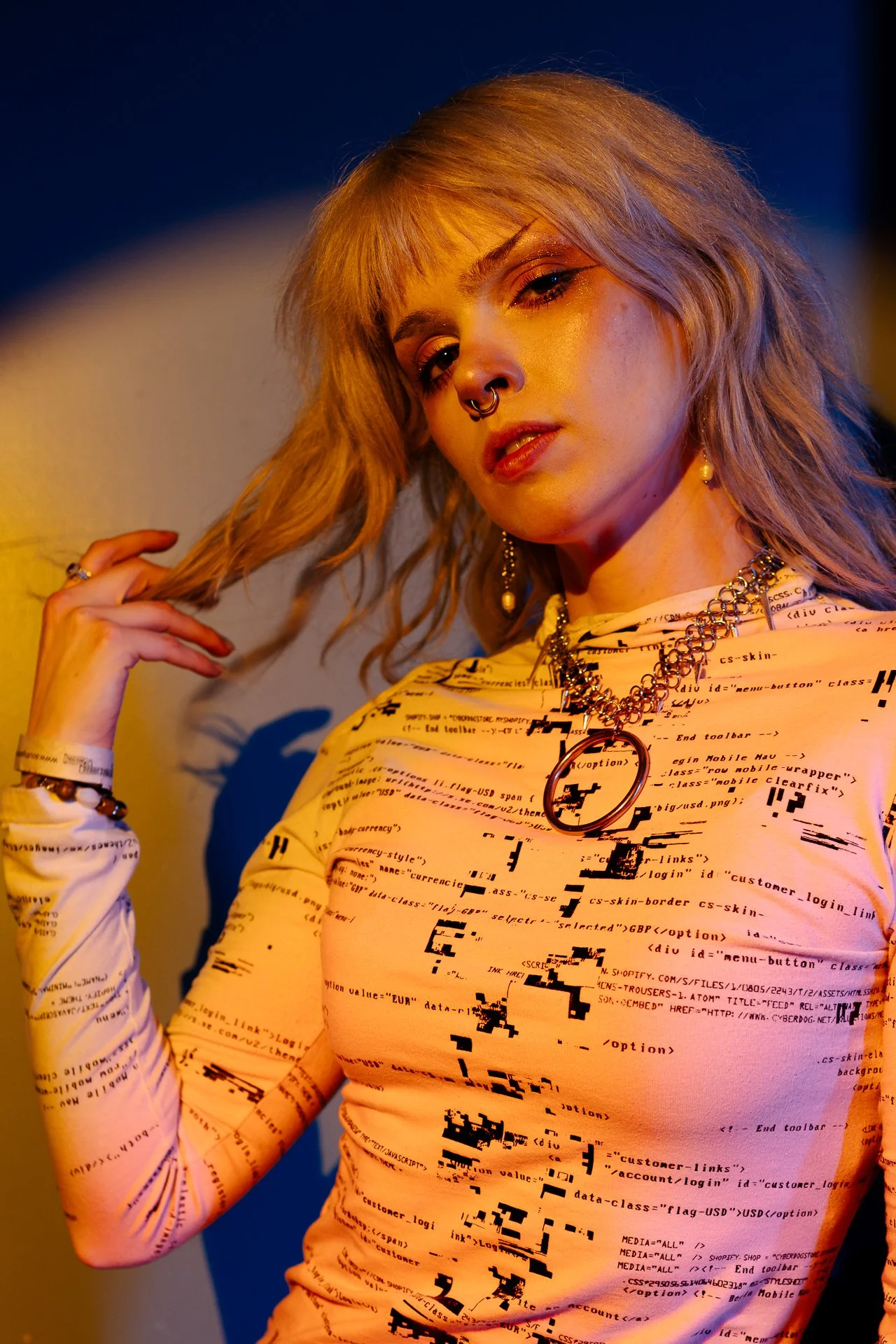
Photo by AMANDA MACK
Sappha arrives at the venue as I'm cleaning my glasses. I don't wear them for fashion — I'm blind as a bat without them — but I can still make her out in the blurriness. She is naturally tall, but the platform boots she's wearing are adding height. She also has an icy, blond shag. She attempts to shake my hand with several canvas totes weighing down her arms. It's a valiant attempt that we both chuckle at. Her entire performance setup is in them — a sampler with her setlist tracks programmed in, cables, and white angel wings.
She’s a one-person music and video production house, and she does it all from her apartment. It’s one of the many things that drew me to her; she’s someone decidedly taking advantage of the There’s-A-YouTube-Tutorial-For-That era of the internet we’re in. Hers is often the only name found in the production credits of her releases. And when it comes to the music videos, she’s listed as the director, the editor, the colorist, and can even have a hand in the overlays and multimedia assets. She does get help filming most of them, but she’s also been known to take a camera into the woods and use a tripod to film promos and visuals on her own.
Photo by AMANDA MACK
There's a line at the only main entrance of the Southgate Revival House in Newport, KY — a former Grace Methodist Episcopal Church that’s now a three-stage music venue. She is polite as she cuts through the cluster of people jammed at the entrance and into the building for our interview. I'm more than happy to follow her lead. Following my lead would have meant waiting meekly near the entrance until it cleared, which might have taken a while. Not only is Sappha's show taking place — a supporting spot for an on-tour Wes Parker — but there's another show happening at the venue with the same door time as our interview.
It's taken a lot for her to get to this place — a place where she’s full of drive, but also full of grace; someone who moves through not just crowds, but the world, confidently and mindfully.
Sappha, whose real name is Levi Antoine, grew up in Ross, Ohio, a suburb about thirty minutes outside of Cincinnati. She found her love of layered, choral harmonies from singing in the choir. She was Catholic growing up. That was about all the love she could find in Catholicism, however. She left the church when she was thirteen after being skeptical of the homophobic and anti-abortion rhetoric from childhood. “Growing up in the church and in the choir was weird for me. It was very imposed. There were a lot of conservative beliefs that we were expected to take on at a very young age. […] I definitely was resentful for a long time about growing up in the Catholic Church for that reason because I felt like I couldn’t be myself, but I’ve made peace with it now in a way that I think is reflected in my work and my presence online.” Antoine credits writing songs like “holywater” and being allowed to film the music video at the First United Methodist Church of Hamilton, Ohio with helping her to make that peace. It was around the time she left the church that she started going by Levi, a name she found to be “a very feminine male name”. She would make the name change legal when she turned eighteen. “I thought when I was younger that I was non-binary,” she explains. “And I no longer identify that way anymore, but when I was in middle school, I changed it. I still love it a lot. I think it’s super cool.”
Photo by AMANDA MACK
In her teens, she learned to play the guitar and produce her own musicin Audacity. She started releasing music under the name Levi Rose around the end of 2017. She had a little trouble getting her songs to an audience, however. Crippling stage fright and social anxiety hindered her from playing as frequently as she wanted to in the coffee houses those songs were made to be played in. Her move to downtown Cincinnati was the start of her transformation. Antoine now participates in a fashion show called Reclaimed Runways, where she performs and walks. That put her alongside seasoned queer and drag performers, which forced her to bring her A-game. “So many of the drag performers here are athletes,” she says. “They’re doing crazy tricks, and when they dance on stage, it’s like they’re giving it everything. […] I’m on the same bill as drag queens hanging from the ceiling and standing upside down, and I’m like, ‘Okay, I want to bring some of this energy’”. The move to downtown also changed her proximity to the local music scene and allowed her to meet the people who would become her community and mentors — Siri Imani and Jess Lamb. Lamb owns an independent, woman-focused record label called City Queen Sounds, and Imani brought Antoine into her philanthropy work with the organization she founded, Triiibe Foundation. Collaborations with Cincinnati heavy hitters like Turich Benjy helped her build self-validation outside of her DIY bubble. She appears on his 2024 album SOMETHING OUT THE BLEU on the track“Make me a BELIEVER.”They recorded in a professional studio. She was expected to write her own verse and contribute to a track with production already well ahead of her. Antoine works quickly, but rarely on someone else’s timeline. “I think we only did one or two sessions for that song,” she says. “So it was motivation to rise to where he was at and his workflow. It kept me accountable to have to work with somebody else’s deadlines.”
Photo by AMANDA MACK
Greatly inspired by Grimes, Imogen Heap, and Björk, Antoine dropped a blitz of releases in 2024 that firmly established her current sound. The first out of the gate feels like her most comprehensive release to date — NARCISSISTIC SUPPLY & CO— despite tagging it as a “demo LP” on Bandcamp. While it heavily references Dante’s Inferno throughout, on tracks like “CONTRAPASSO” and “WHOREMONEY (sappha mix)”, which have features from Lamb and Imani, you can hear her drawing from her own inner inferno to take back her power and bodily autonomy from the sexual and emotional abuse that she endured in the earlier part of her career. She withdrew her work for a while because of it, but in “WHOREMONEY” she confidently declares, “Yes, my dissent is patriotic /Tired of repeating history so I’m off it / Don’t need you to pay for your mistakes, babe, I got it /Whoremoney already made me a profit”. In March of that year, she released the 4-track demos EP perfect chaos, and in June, she put out an album of covers cleverly titled saffeinated!, running everyone from Bo Burnham to Bon Iver through her self-described “poetry steeped in hallucinogenic pop” filter. Those older songs from her teenage years are on her YouTube and her Bandcamp page as a collection called puzzles: demo EP (levi rose) & other acoustic songs. She’s still proud of them. They’re minimally-produced, stripped-down ballads that are soul-baring and sincere. They’re composed by the most powerful trio in music — a girl, a guitar (or sometimes a ukulele), and an unguarded heart. Those songs are much closer to Kimya Dawson or Phoebe Bridgers than to Grimes, and while her music has incorporated a few looped samples and chopped vocals, the vulnerability remains ever-present. Her vocals on songs like “water where i am” from this year’s righteous lamb EP still cut powerfully through the electropop production: “I stress out everyone around me 'cause they see the stress that's on me/Growing like a vine that's on the wall/The wall that I'm still talking to/'Cause I just wanna talk to you.”
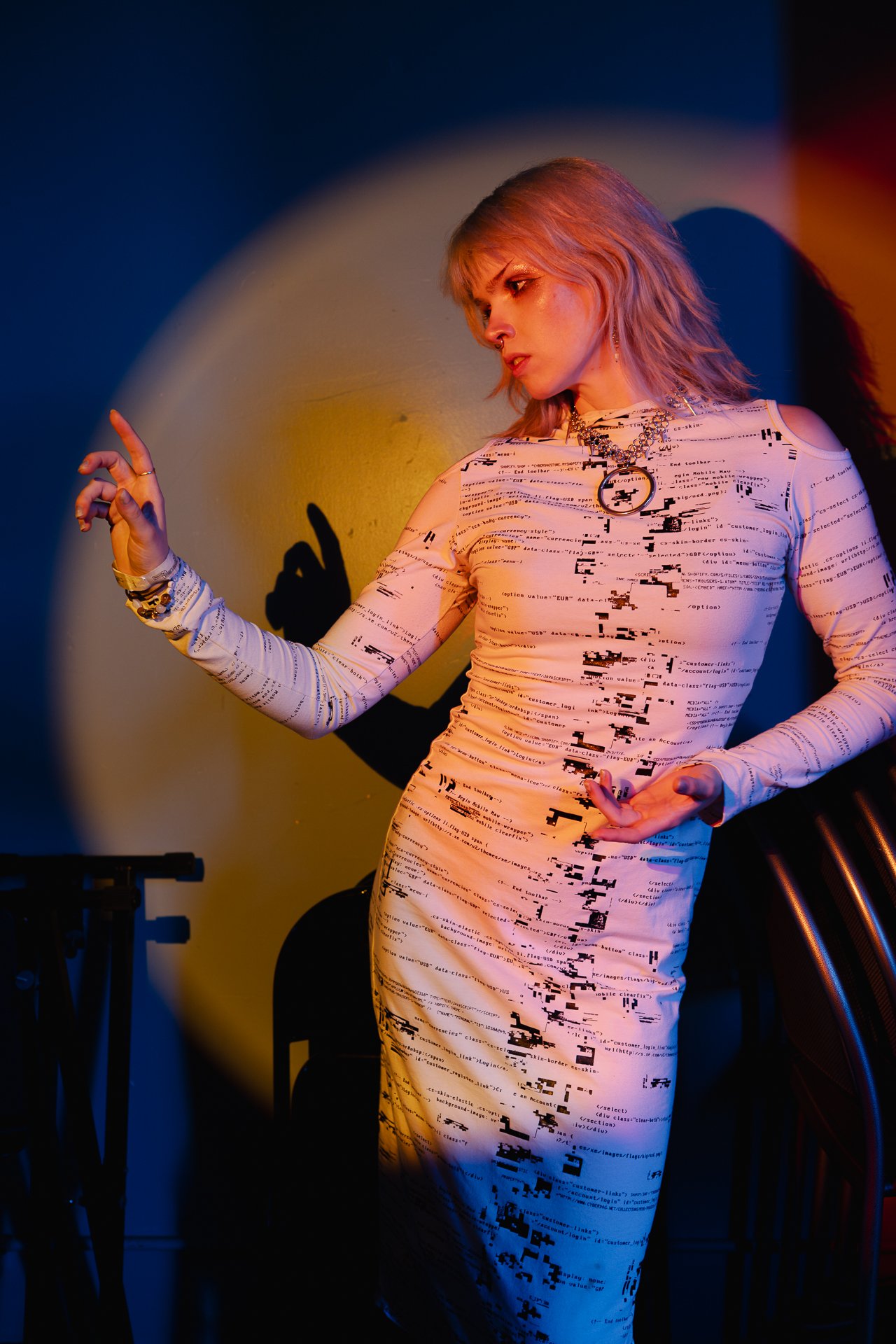
Photo by AMANDA MACK
When I mention Eric Nally, I’m delighted that we both light up the same way. I'm a longtime Foxy Shazam fan who's been following Nally's solo work for years (You can catch me in my 2015 Nissan Altima, belting out “Full Moon” as if I wrote it). And Antoine has been collaborating with him over the last few years. Their song, “new knife,” came to my attention through his Instagram promotion, and it led me straight to her impressive discography. Nally got to be impressed by it first, though. He still resides in Cincinnati and keeps his finger on the pulse of the local music scene. “We’re both fans of Kate Wakefield and Victoria Lekson, who I perform with sometimes — she’s a harp player. He reached out to me at the end of 2024, and I had some demos that I sent him. One of them was ‘new knife,’ and I wasn’t even sure there was room for another verse on it.” But she made the room. She extended the loop in the song so Nally could fit in the verses he wrote. “I dropped it in my Logic [Pro] file and I was like, ‘Whoa!’” She laughs. “This is a beautiful song!” Antoine had written her parts months before. It was a demo sitting on her hard drive that she’d planned to put on her first EP, righteous lamb. She wrote it as a promise to herself to never self-harm again even as she was still in the midst of her battle with it. Nally’s verses feel like a response to hers that beautifully support her vulnerability: “New knife, we could fall on our blades/Face the angels in the grass where we lay/Don’t be scared reflecting on those days/ Oh, my love, it’s the edges that frame us.” That collaboration blossomed into a three-song EP called Archetypes due out soon. “We recorded some of the vocals in my apartment, so I got to keep my DIY ethos. He encouraged me to produce a lot of it. I felt grateful that he was so trusting through that process because he’s worked with so many different producers. I really look up to him. He’s been a mentor to me just by the way that he is, and he’s so zen. [He] wants to push something forward and make it the best it can be.” It feels like Antoine senses the contradiction her statement creates about Nally. Zen and Eric Nally don’t feel like they’ve ever been in the same room together if you only know him from his stage antics. I’ve seen the gentler side of him in interviews, but she’s created alongside that version of him in person and assures me that that’s his true nature. “As charismatic and crazy as his stage presence is, he’s a very quiet and peaceful person to work with. […] It was beautiful to work with him.”
Antoine found her spirituality through the character of Sappha and hopes that listeners of her music are granted the same experience. “I hope they connect with spirituality in the ways that mean something to them, and [that] they feel like they get to decide what they worship. Sappha is me finding out what I worship.” She doesn’t want that experience to be only sad, however. “I hope that they’re not afraid to confront the sad parts of themselves because Sappha’s a very sad project,” she says, “but it’s also a very sexy project, and those two things can co-exist!”