
The Quiet Power of Liam Kazar
On isolation, analog sound, and Pilot Light
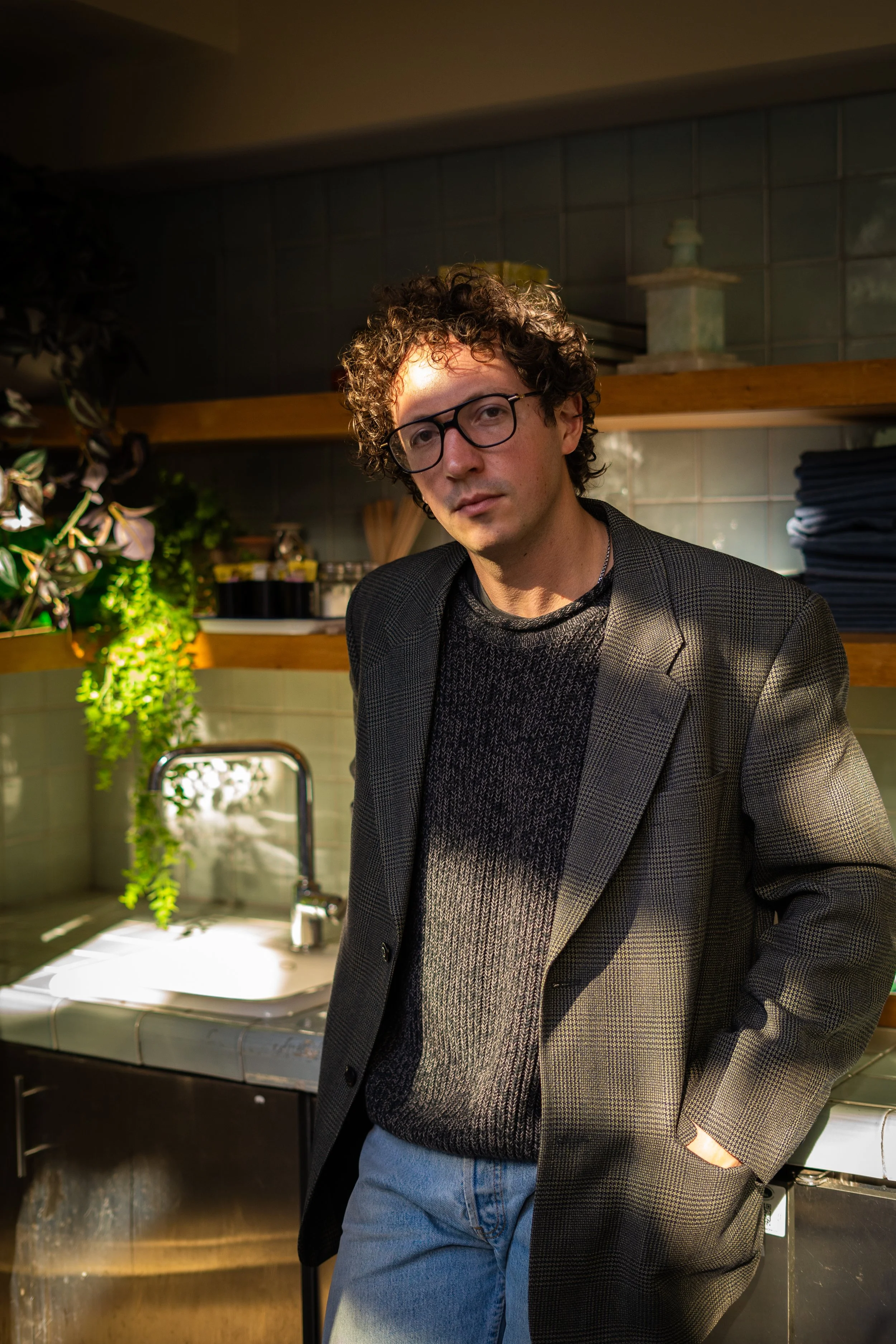
Photo by BAILEY BLAKE
Liam Kazar's aviator glasses caught the light, glinting as he weaved his way through the cafe of the Hoxton in Williamsburg, ordering a plain black coffee before sitting down to talk. His style, from his worn jeans to his vintage boots that he picked up on tour, was just as relaxed as his demeanor.
He sat across from me at a small marble table, hands together as I set up my phone to record. He looked around and sipped his coffee, moving at an easy pace even though he had to leave in about an hour and a half. That same relaxed feeling comes through in his new songs, making it easier to see the world behind his album Pilot Light, which follows his lively debut, Due North.
The record blends folk, rock, and jazz, creating a timeless, analog, warm, and textured sound. Everyone I've introduced to his music has found it deeply peaceful and addictive, often listening to the entire album from start to finish.
Kazar's deep, smooth voice has a steady, easy quality that listeners can feel. He's a reserved person, and he wrote most of Pilot Light in quiet places like Wisconsin and the Catskills. That isolation comes through in the music, with dry, raw vocals that add honesty and warmth in a digital world. In an age when music can be made flawless by technology, his clear, live vocals stand out. In the lines "I feel your ghost inside these walls, The memories are ringing in my ears, I pace the floor, I walk this whole town, With a worried mind tracing back the years" from his song "Next Time Around," his raw delivery shows real vulnerability. It's hard to imagine these vocals sounding the same if they were overly processed by technology. The music stays grounded by avoiding flashiness. Letting the songs be as they are creates a sense of acceptance and contentment.
Chicago, where Kazar grew up, introduced him to the music world he’s still part of. But his musical journey really began at home. "You go in, and you take a left? Piano's right there," he says, showing how music was always around. "I have early memories of my dad playing 'Heart and Soul' on the piano and telling me to do a solo only using the white keys," he says. He also recalls Christmas dinners when his dad played acoustic guitar.
His family's basement was filled with instruments. His dad collected music gear from the 80s, so their basement had a full PA system, microphones, and drums. When Kazar got serious about music, their house became the place to rehearse.
His parents' records also shaped his taste. "Loving The Beatles and loving Motown is what made me realize that I liked songs, and I still like songs. I love pulling them apart and figuring out how they work. I think more than records, I'm a lover of songs," Kazar says. When asked about his favorite Beatles song, he laughed, "Good Lord!" but quickly answered, "The mystifying things are always just the simplest, most straightforward songs you've ever heard. I might say 'She Loves You.' It's just like, 'She loves you, yeah, yeah, yeah…' It's just so simple, but so good."
I also asked him about his favorites from Motown."Songs in the Key of Life is maybe the beginning of me realizing what a record was," Kazar says about Stevie Wonder's classic album. He adds, "and Ray Charles has always had my favorite voice, though I know he's not Motown."
In high school, Kazar needed a music credit and already played bass, so jazz became a big influence on him. "I went in not really listening to jazz at all." He didn't want to learn a new instrument, since many, like the violin or cello, felt like starting over. "I played the bass in the orchestra, and the teacher suggested I be in the jazz combo." Ravinia, a larger program, wanted him to join, even though he'd only played upright bass for two months. "I was thrown into the deep end with all these jazz aficionados, and I had a lot of private study time with a great pianist, Willie Pickens, because he had to get me up to speed with all of these great musicians I was playing with. He was really gracious and kind, but also pushed me. And I just fell in love with it. Passion is infectious."
He learned jazz on the fly and soaked up the passion of those around him. But even as his skills grew, something about jazz remained refreshingly simple. For once, he didn’t have to pick things apart or analyze every note; he could just listen."The thing I love about jazz and instrumental music is that I can just enjoy it as a fan. With songs that have lyrics, I often find myself analyzing them, but jazz and other instrumental music just wash over me, and I love that feeling." He compares it to listening to Brazilian music or to other languages that may be foreign. "To me, that's a really important part of still loving music and having a relationship with music outside of being a musician."
Kazar’s sister, Sima, is also a musician. Like him, she plays several instruments, but while Kazar focuses on guitar and bass, Sima is mainly a singer. "She's a true singer," he says, noting that she moved up through the choir.
"I didn't have a knack for harmony singing, and even now, when we play in bands together, I just ask her, 'What do I do?'" Sima can quickly come up with three-part harmonies and tell Kazar what to sing. She sings all over Pilot Light, with all the background vocals done by her alongside singer-songwriter Hannah Cohen.
She plays bass in Jeff Tweedy's band, guitar in her own band, and keyboards for her solo music.
They grew up just a few blocks from Jeff Tweedy, who met their family in high school. "That's certainly a huge Chicago touchstone, not only to know Wilco as a kid, which I did—I went to their concerts and was so obsessed with their music—but then getting to know Jeff and his son Spencer, and playing music with them for the last ten years. That's about as Chicago as it gets."
Kazar played lots of gigs around Chicago as a teenager. It was easy for someone under 18 to play shows, usually in small venues with relaxed crowds of friends and family. When asked about a memorable moment from his early days, he talked about a fundraiser his old band, Kids These Days, played for the 2010 Haiti earthquake. The event, called Every Drop Counts, aimed to provide drinking water to those affected. It was his first time performing with adults, and activist Fred Hampton Jr. spoke at the event. "I remember thinking 'this is the real deal,'" he says. "We're with the grown-ups now." Playing to a full audience instead of a small crowd was exciting. "It was my first time playing a truly packed house," he recalls. "That's always a big moment, where you think, 'I would like to do more of this.'"
Kazar still spends a lot of time in Chicago, so he doesn't miss it much—it's still part of his life. "But what I miss most about the Chicago I grew up in, I used to go to Beer League softball games at the park by my house and eat three hot dogs…"

Photo by BAILEY BLAKE
Now, Kazar lives in Bed Stuy. He moved there about two years ago, subletting for a year and a half before officially settling in January 2025.
He had just ended a relationship that mostly took place in Kansas City. "I felt like I just didn't want to restart my life back in the city that I grew up in."
Kazar felt ready to start fresh in New York. He already had music connections there from playing with his friend Sam Evian for about five years, and the musicians he met through Evian all played on Pilot Light. "I just feel like I'm part of this community as much as I'm a part of the Chicago community." Moving to New York let him try something new without being alone. "I ran out here in my parents' car with all my stuff, then drove it right back."
When I asked if anything about New York surprised him, he said, "Not all bodegas are made the same. It took me a while to find mine." (He's right, by the way.)
Aside from bodegas, he's been coming to New York his whole life, so he's used to the bustling lifestyle. "I feel like as much as I'm not a New Yorker, I know this town."
However, it was still odd for him. He found himself uncertain what to do with his time. "I think the thing I didn't realize until I moved here is that everyone's got a job, and I didn't have a job when I was here. I was bored and didn't know what to do with myself, and I wondered, 'What is everyone doing? Everyone's got a job.'"
It's hard to sit still in New York; you always feel like you could be missing out on something.
"Even if you have money and you don't have to do something, you still have to do something."
Kazar finds inspiration in Brooklyn's music scene. "People are so good at their instruments. Jumping from band to band and everything. I feel like a tourist staring up at a skyscraper of massive talent." It pushes him to practice more. "It makes me get my shit together." For all his accomplishments, it's motivating to see his drive to keep improving.
He has favorite spots to find inspiration and connect with others, such as Night Club 101 in the East Village, the Bowery Ballroom, and Bar Lunko in Bed Stuy for jazz nights.
One of his favorite shows in New York was seeing Allegra Krieger open for Katy Kirby at Bowery Ballroom in March 2024. "I was completely taken by her songwriting. That's maybe the most heavy-hitting show I've seen in New York City, and it was before I lived here."
Despite all the energy and inspiration in Brooklyn, Pilot Light was created in much quieter places.
Kazar wrote most of the album in Wisconsin and the Catskills. These peaceful places gave the record a calmness he might not have found in the city. "I really wanted to be as direct and honest as I possibly could on this record. And I feel like the quiet and the distillation of anything to do helped me do that." It's hard to focus in busy cities like New York or Chicago, so being in a steady place helped him stay centered.
Kazar's songwriting often comes from a place of isolation. It's less about where he is and more about who he is. "I live in my head a lot. Sometimes people interpret me as, you know, not giving a shit or being aloof, which I feel bad about." He added, "I'm a bit reserved. I've always been that way." Even so, he never seems careless or unfriendly.
Given Kazar's love for songs and lyrics, when I asked if any lyrics stood out to him, he said, "I'm always inspired by saying it all with as little as you possibly can. That always blows my mind." He mentioned Hank Williams as an example. "I love the lyrics in his song 'Half As Much.' 'If you only love me half as much as I love you…' Just that phrase alone, 'you wouldn't worry me as much as you do.' I'm a sucker for a self-deprecator." He also likes Waylon Jennings' version of "That's What You Get for Loving Me," but says, "It'd always just rub me the wrong way. It's a great song, and Waylon's great, but he just sounds like an asshole in that song. I don't gravitate towards that, but Hank Williams, being the dope and the sad sack, I love that."
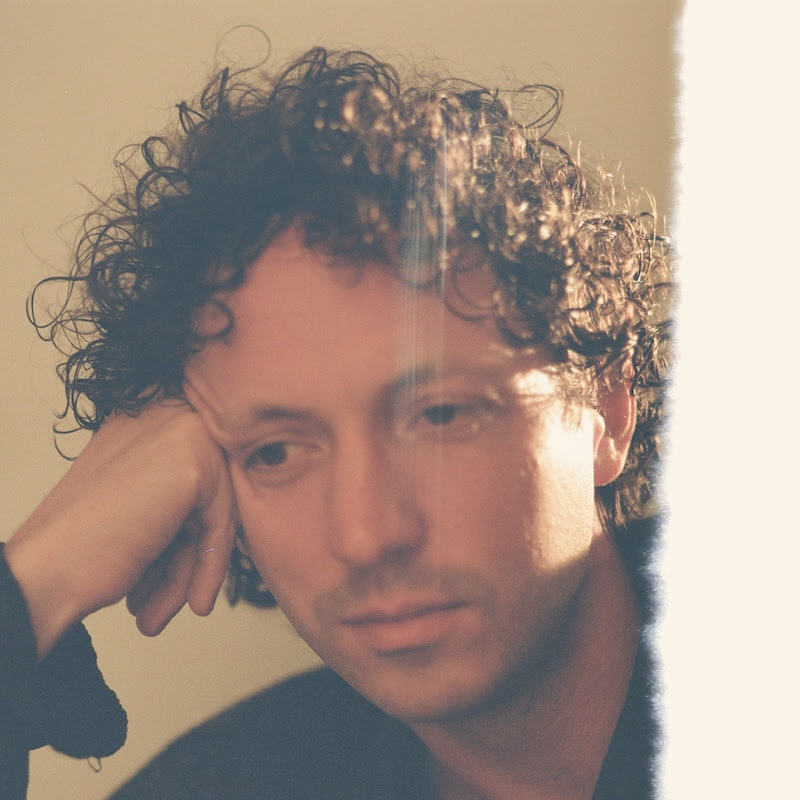
Pilot Light album cover
Pilot Light is something of a breakup record. Not every song is about it, but the theme is there. One of the hardest songs to finish was "Holiday," about a breakup. It was the last track he worked on. The structure and verses were done, but he kept putting it off. "It got to the point where it was time to go. I told everyone to give me 15 minutes, then ran outside. It was summer. I didn't even take the guitar out because I knew the song so well by then and just needed to solve the riddle." The song is simple and direct, but it still hits hard. Sometimes, a song just needs more time.
"I'm always trying to surprise myself," Kazar says about his writing. "And when one of those little images pops into your head, and you don't know why, but it just does, and you write it down, those are always the big surprises.”
He had a special moment with the track "The Word the War." "The beginning of this song, that was just an image that popped in my head, and I have no idea why it did. A queen on a throne in a forest… I don't know, but that was where it started. It just popped into my head."
Some songs changed a lot during recording, like "Listening." It's a standout track with a peaceful jazz lounge feel—soft piano and fuzzy static in the production that makes it feel vintage. The song shows the simplicity Kazar loves. "I had put together the skeleton of it, but I really can't take any credit for the arrangement. I didn't know what to do with the song." He struggled with its direction, but producer Sam Evian, pianist Michael Coleman, and drummer Sean Mullins helped shape it. "I was just singing the melody, basically."
"Pick Up the Pieces" was the last song they recorded. It's near the end of the album, and Kazar didn't think much about it at first. "I had some other songs that I thought were surely gonna be on the record, but that one was just in case, so we had a little wiggle room when deciding what the record was going to be." As Pilot Light came together, it became clear that this song fit well.
Isolation does more than make music feel warm and personal. "There's an accountability you can give yourself when you're isolated," Kazar says, pointing out how important editing is to his process. He looks to Bob Dylan's archives as an example of careful editing and believes that taking time to refine your work leads to more honesty and focus. This approach shaped Pilot Light. "When you're making a record, you're listening to your demos, and you're focusing on it, and I listen to my demos over and over and over again, trying to work out lyrics."
Kazar used dry, unprocessed vocals on the album, which could be an uncomfortable choice for some. "It just immediately felt like the right thing to do for this record. I was in a place where I was becoming a more honest and vulnerable person at the end of a relationship, and I was opening up to people a little bit more than I ever had." Singing so openly didn't bother him. He points to old Frank Sinatra and Ray Charles records, noting that some ballads are very dry, like Sinatra's "Close to You." "I respected its honesty and wanted to try more of it in my life. Just being like, 'here's my voice,' you know?'"
The analog sound of the record is more than an artistic choice; it's also Kazar's way of rejecting the digital world. "I don't understand it. I don't seek to understand it. I'm so much more interested in humans, and I will be forever," he says. "I'm a bit of a Luddite in general." For the technical side, he relies on Evian. "He makes technology seamless, and you don't even notice it. Oftentimes, he'll put something over the screen, and he works really quickly. All of the technology is just in the background, and you don't even notice it. So, I really have to give him credit because it let me not have to know about it or even pretend to."
Most of the gear used for the album was vintage, from the 1960s to the 1980s: tape machines, mixing boards, and amps. But the album's spirit was inspired more by songs from that era than by the equipment. "It was a sensibility of sound that Sam and I kept in mind while we were mixing the record. We wanted it to sound timeless, and I think there are aspects of records from that time that sound more timeless to our ears than others." What makes an album timeless is up for debate, but relatability and impact across generations matter. For Kazar, sonic timelessness is about balancing familiarity and uniqueness. "There's transparency that begins in a certain way, around the point where the technology gets to a place where there's very little between the music that's happening and the music you're listening to. Or at least the perception of that. So when you're going for something really honest or direct, we were looking for transparent technologies and transparent ways of making music."
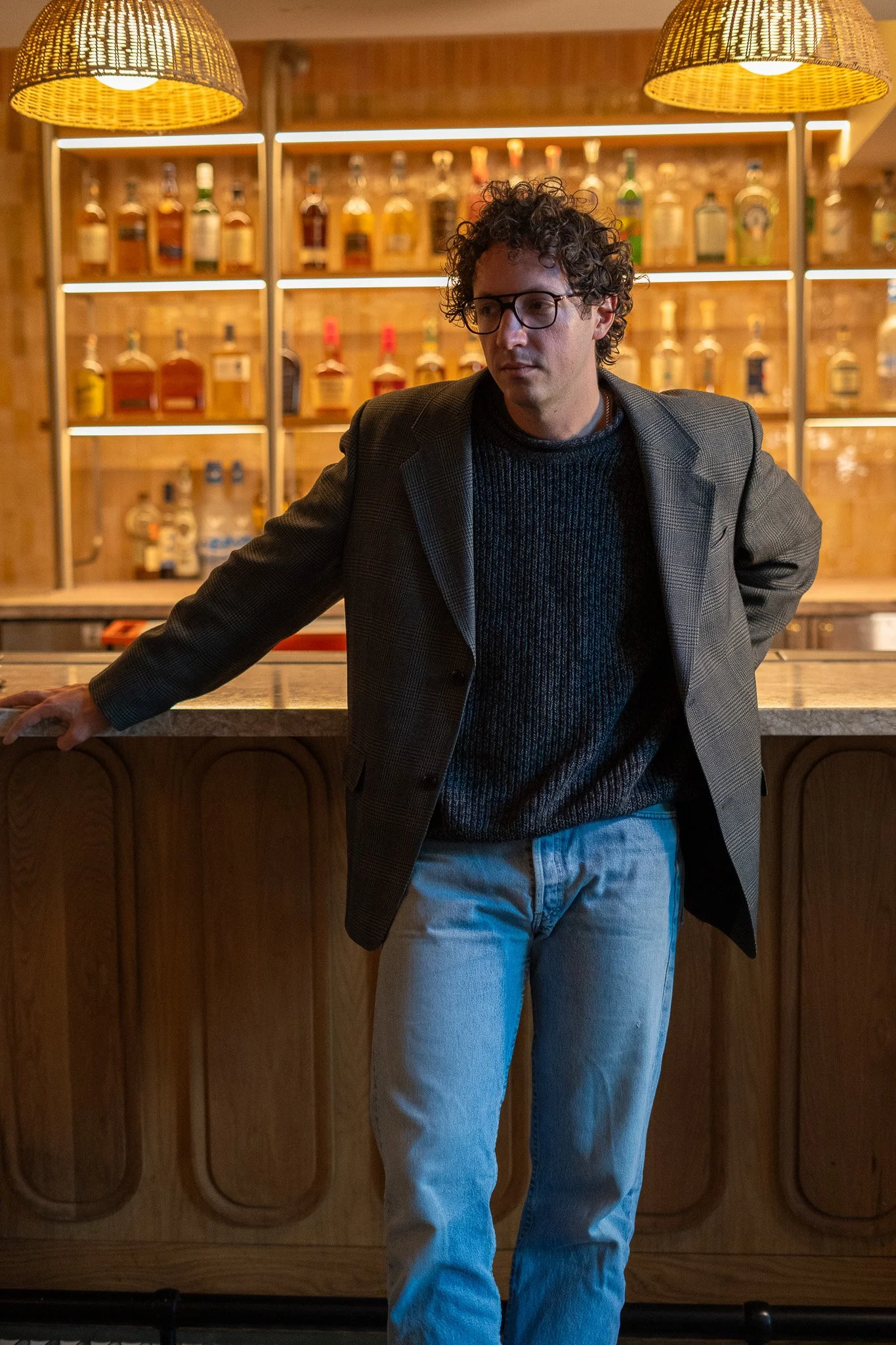
Photo by BAILEY BLAKE
I first heard Kazar through his debut, Due North, in 2021, so I asked how it compares to Pilot Light, which came out about four years later. "Pilot Light is like a quick pasta made with pantry items," Kazar says. "Due North is like a potluck dinner of everyone bringing these different things made in different places." Listening to both albums back-to-back, the comparison makes sense.
"Pilot Light rarely had more than two people in the room at the same time, and most of the time it was just one person at a time doing overdubs. And the first song on Pilot Light was recorded entirely during the pandemic, with no one in the same room. Everything was just over email and sent in." This shows the album's sense of isolation. "So, Due North is more like Frankenstein's monster, while Pilot Light is just a tadpole turned into a… full ribbit!"
Your first record teaches you a lot, and so does your second. A lot can change between them, and they can feel like two different projects. Still, "You only get to make one debut album." Unless you join a new band or reinvent yourself, the point stands.
"Due North taught me what it meant to put your life on a record in a way, and Pilot Light taught me how to mind the present because I wasn't dumping everything. It wasn't all leading up to that moment; it was, for the first time ever, a continuation of something. And that makes you sort of dig a little deeper into where you're at. It did for me at least."
If you are at all familiar with Kazar and have seen his Instagram, you know he is a big cook, to the point of making meals inspired by songs on Pilot Light. He is also big on listening to music while cooking, even more so than when listening in a car. Having a good cooking record is a high compliment to Kazar. I had to ask what the qualities of a good cooking record are. "You've got to have dynamics to be a good cooking record," he tells us. "You want little things to pop out and catch your ear. I think dynamics are generally underrated nowadays. When you listen to older records, they can get really, really quiet. I think one of the greatest examples of dynamics is Frank Sinatra's 'Fly Me to the Moon.' Listen to that song, and you'll see what I'm talking about when I say dynamics." Kazar isn't about overproduction, as you may have already noticed. "There's a static level, which I hear records a lot of the time, and they've been mixed and compressed to oblivion, where they're just the same level, same decibel the entire time, and that's not cooking music to me."
I asked Kazar if he'd ever make a music-themed cookbook. "I think I'd need a lot of help, but I have a couple of ideas."
Kazar cares more about longevity than legacy. He's toured and worked with artists of all ages, from peers to legends. It's natural to think about his future. "I think you have to have a blind ambition. It's true what they say, you have to make the decision that this is what you're gonna do with the rest of your life. Damn the torpedoes." He's grateful for the opportunity to work with older musicians, who taught him how to make a music career sustainable. "I learned a lot of that from Jeff Tweedy, but also other people from other bands I was in, like Steve Gunn." Touring with them showed him a practical approach. "We were in sprinters and vans. This is how you do this and don't lose your mind." For him, it's about being practical: drinking water, running on days off, eating good meals, and being comfortable alone. "You just learn. There's a bit of osmosis that happens."
Kazar has toured a lot. One of his top three tours was the most recent one with Jeff Tweedy's band. "My sister was on it, and the Tweedy family is like my extended family, as well as Macy Stewart. We've been playing music together since we were 14, so that felt like a family affair." He also toured Europe in the summer of 2023 with his friend Kevin Morby, where Stewart opened. "That was the most continent-spanning European tour I'd ever done. I went to so many new places."
Kazar believes his best tour is still ahead of him, but he's already had some great experiences.
Some of his favorite places to play are Berlin and Manchester. "I just feel like they have great audiences." He also enjoys playing in small towns. "I love an underplay in a tertiary market. I feel lucky to have done that many times. Tertiary is an industry term for a B-, C-, or D-market. One time, I was with Jeff Tweedy in a small town in Australia. We played a packed show, and even the mayor came. They cooked his food in the back, and I thought, I am so far from home right now, I can't even comprehend it. I bet none of these people have listened to the record very much, but they're here."
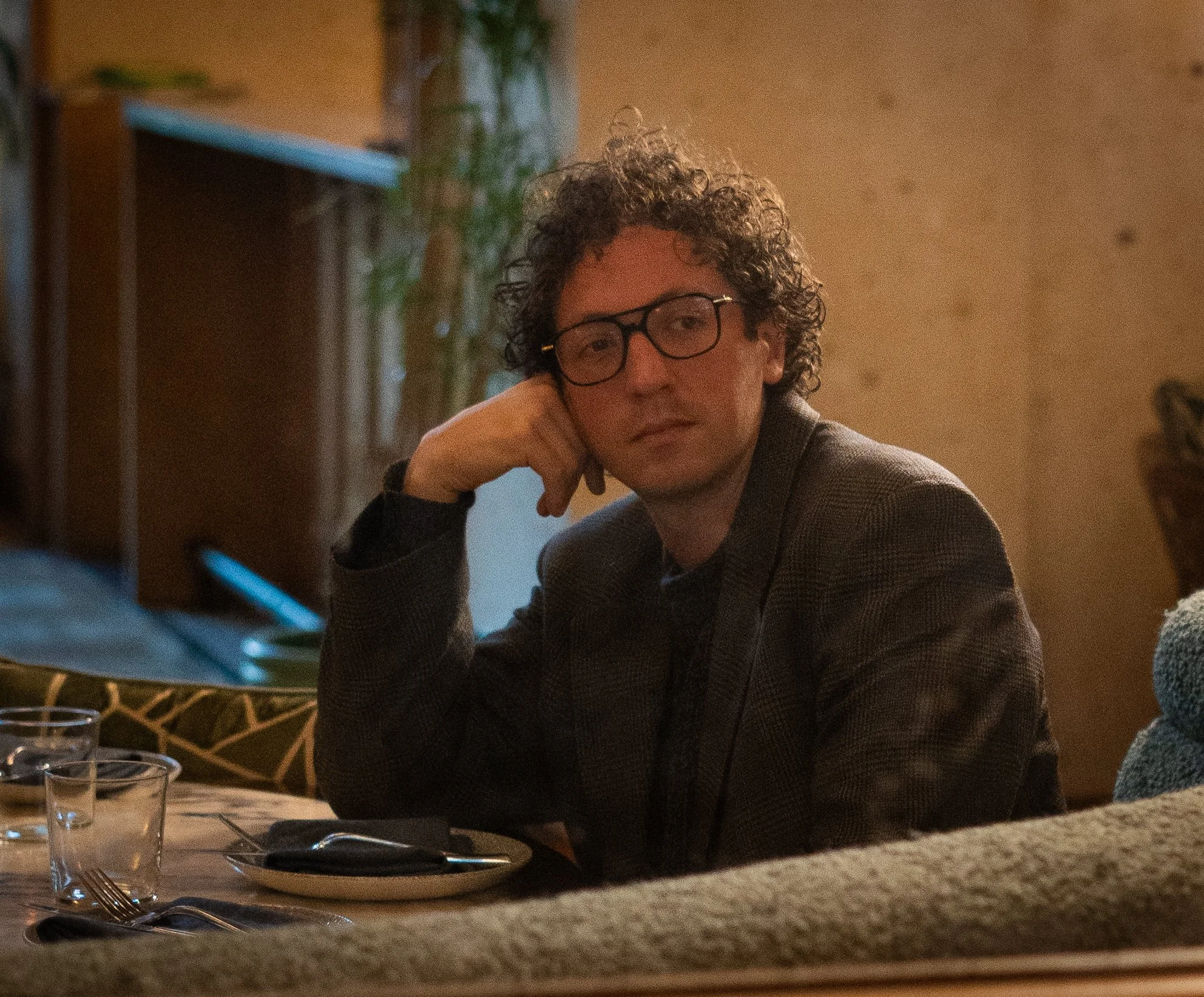
Photo by BAILEY BLAKE
Looking at the big picture, Kazar isn't too worried about his body of work; he just wants to keep doing this as long as he can. "That's more important to me. It's not for me to say what the body of work ends up being or what it means. It would be the greatest gift to do this as long as I wanted or as long as I am physically able to." This focus on longevity ties back to his food analogies for Pilot Light and Due North. When asked what he hopes for at 60, he says, "I'd like to be playing shows, writing songs, and having a good sleep schedule. And all my teeth."
This vision of his future is like hoping to keep a favorite recipe simple, with good ingredients, well prepared, and shared with people who matter.